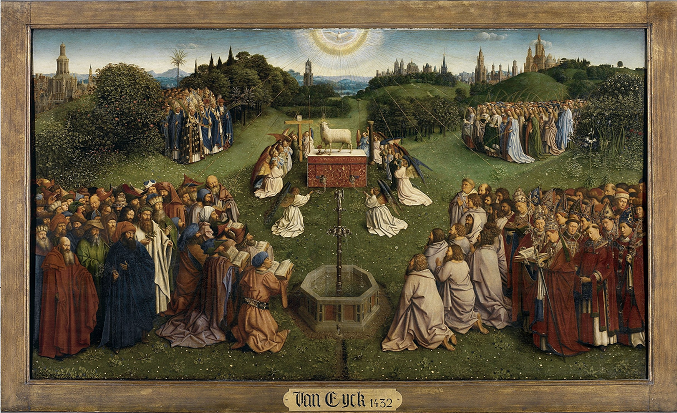
 Jan and Hubert van Eyck, The Ghent Altarpiece, 1432.
The difficulty explaining why I am Catholic is that there are ten thousand reasons all amounting to one reason: that Catholicism is true.
— G.K. Chesterton, Twelve Modern Apostles and Their Creeds, 1926
This is in some ways a response to the challenge of 1 Peter 3:15: “Always be ready to give an explanation to anyone who asks you for a reason for your hope…”
I won’t for a moment suggest that the credo can be improved, but here’s how I’d articulate Catholicism in my own words:
I believe that the eternal, omnipotent, omniscient, omnibenevolent, perfectly just God created us out of sheer agape, and also granted us free will1, which we took and abused (sin) like a knot of impudent toads. And yet He pursued us like the Hound of Heaven—being madly in love with us—through the centuries via prophets and kings and through a special people (Israel) and finally through His only son, Jesus Christ, to save us from ourselves (because addicts can’t just pull themselves up out of their addiction “by their bootstraps”), which He did by being horrifically tortured and executed, though innocent, on a cross in order to expiate the past, present, and future sins of the world2. He founded and left us His Church to give all the means to be saved—and then divinized3—through that sacrifice.
And if I had to summarize what’s truly special and inimitable about Catholicism, a few things rise to the top:
So that’s the what.
But it begs the why and how.
I don’t want to suggest this is a purely intellectual endeavour; after all, Christianity ultimately is a relationship—not a philosophy—and, in my case, a messy one: full of missteps and unearned grace, some of which I recognized at the time and much of which I didn’t.
I’m a Cradle Catholic, baptized 15 days postpartum, and so the first and simplest answer of why I’m Catholic is that I was “brought up” in the Faith, which I’m quite proud of5 (fidei donum). Mass every Sunday with Mom at the piano, leading the congregation in sung prayer; with Dad ensuring we didn’t screw around and participated (i.e., sang audibly). They were carrying a tradition passed down from their parents6 and so on. This is more than my immediate family: four grandparents (one a convert), 19 biological aunts and uncles, family friends, et al. Kindergarten through third grade, and then eighth through twelfth grades were Catholic schooling, and while it was maybe catechetically unremarkable, I was surrounded by many people living out their faith to the best of their ability (which carries a lot of weight).
Looking back, I’d say the Faith was in the air I breathed before I ever had the vocabulary to articulate it, and that turned out to be no small thing.
My formation in Christianity and Catholicism was multifaceted with many lovely people playing parts, but at the same time it also lacked rigor—for which I take full responsibility as I was given the gift of attending wonderful Catholic institutions with unfettered access to marvelous teachers. High school was diocesan, and so it was my Uncle John who turned me on to the Jesuits (he having been formed in the Society for the better part of a decade before deciding to exit). And so I chose Boston College for undergrad, its (Jesuit) Catholicity no small factor, and once there my faith indeed expanded…in the classroom certainly (e.g., with Fr. Michael Himes), through various retreats and activities (e.g., Liturgical Arts Group), and during many late-night discussions and debates with clever friends7. Kairos VIII impacted me enough that I joined the leadership team of a subsequent one; but theologically it only went ankle-deep, and so it demanded I take the next step on my own, which I failed to do…at least at that time.
And then came a shake-up. There I was, a Cradle Catholic, at the kitchen table of a lovely Protestant couple in the American South, being unmoored as they led me through “The Romans Road.”8 I hardly pushed back because despite my 13 years of Catholic education and twenty-some years of Mass attendance and four sacraments, I really didn’t know the Faith well enough to defend it, and so I was easily persuaded of Protestantism.
I didn’t stay “Protestant” for long, but the detour was profitable: it stirred a hunger within, and I began my own investigation with the help of C.S. Lewis, Thomas Merton, et al.9 The Baptist encounter wasn’t so much a failure of my earlier formation as much as a sign that my earlier formation needed to become mine. It was a transition between my inherited faith and my examined faith.
The hunger from that period didn’t vanish, but it did go underground for a while. While I stayed connected to parishes through my twenties and thirties, whether it was St. Ignatius in Chestnut Hill, St. Mary’s in Ann Arbor, St. Clement in Chicago, or St. Dominic’s in San Francisco; I’ll be frank with you: this was my Catholicism-as-social-club era—Theology on Tap, young adults groups, and various choirs. At the same time I was staying away from Confession, receiving the Eucharist unworthily, generally mired in sin, though mostly unaware of it—coasting through a spiritual fog I didn’t know I was in.
I say this not to be dramatic about it, but because it’s just the truth, and I suspect it’s the truth for a lot of people in the pews—going through the motions, not quite awake to what’s really on offer. And yet, the Lord was in it anyway. He was in the friendships, in the music, in the fact that I kept showing up even when I was half-asleep spiritually.
A lot of it had to do with my own (slow) maturation and what I was ready for, but St. Dominic’s in particular moved me along the path toward taking the Faith seriously. It had everything to do with connecting with the right faithful peers, with whom we created a Christ-centered atmosphere and set of programs (e.g., Lectio Divina, Intentional Seekers, Emmaus). And through all of it, in retrospect, there was a fairly linear progression toward a deeper relationship with Christ, even if I wasn’t totally cognizant of this phenomenon at the time.
And it was good I kept strummin’ the guitar and singin’ because it was in St. Dominic’s basement choir room that I met a beautiful contemporary choir pianist.
I married “up” in many categories, but faith was certainly one: Lisa’s itself but also that of her family—earnest, natural, bold, everpresent—possibly a gift passed down from the Korean martyrs. Faith occupied an important part of our relationship from the start, but marriage has made each of us work toward becoming more faithful than we thought we would10. And it eventually led us to an orthodox—or orthoprax, as I like to say—parish, Star of the Sea, which has been an incredible spiritual home ever since the Pandemic.
‘Practice Catholicism’ is a funny phrase—like it’s a skill you drill. But it is a relationship, and relationships take the same kind of unglamorous repetition a skill does. My dad oft reminds me I can’t expect to play respectable golf without practice; same goes for the Faith. And just as you get better playing with people who are better than you, being surrounded by faithful adherents does a lot through osmosis.
In late March of 2024, I had a wake-up call. Literally woken up in the middle of the night with panicked thoughts and a racing heartbeat. Now, Lisa and I had binged on some rather intense content about salvation and damnation—soteriologically inflammatory, you might say—that was maybe swimming around in my brain, but without getting into all the details, I had something of a panic attack as I was confronted with my own sinfulness, realizing that there’s a difference between knowing about God and knowing Him.
Here’s the thing I want to say about that, though: it wasn’t a lightning bolt out of nowhere. Every stage I’ve described above—the inherited prayers, the Baptist kitchen table, the choir rehearsals, the friendships, the marriage—all of it was preparation. The soil had been tilled for decades, and the Lord chose that particular night to plant something new.
And I should say: the Faith has become more real to me since then in ways I struggle to articulate. There have been moments in prayer (sometimes just lying in bed in the dark) where something breaks through that I can only attribute to the Holy Spirit. No dramatic visions or anything, but little epiphanies that I can understand to be extrinsic. Again, I wouldn’t say I’m special, and so that makes me conclude (and gently suggest) that it’s available to you, too—and that the Church exists precisely to make encounter with Christ possible.
This blog post is fated to remain in draft status because my faith life is evolving and ever-changing. Each stage has been its own kind of grace, from the childhood absorption to young adulthood questioning to late-twentysomething meandering to the husband and father who is being shaped into a new creation (however slowly and painstakingly).
But I’m convinced that not a shred of it is wasted…for the Hound of Heaven doesn’t give up the chase.
Jan and Hubert van Eyck, The Ghent Altarpiece, 1432.
Crescamus in Illo per omnia,
— ᴘ. ᴍ. ʙ.
I don’t think I fully understood this logic as early as I should have, but it goes something like this: 1) our sin creates a debt of justice requiring satisfaction (in the Old Testament these were holocausts), 2) we human beings, as finite creatures, cannot provide adequate satisfaction for sin against an infinite God, 3) Christ, being both divine and human, offers Himself as the perfect sacrifice to satisfy this debt, 4) this redemption must be personally appropriated through faith and the sacraments (Mk 16:16, Acts 2:38, Ro 10:9), 5) those who definitively reject this gift place themselves outside salvation; ergo, we need a savior and He is Jesus Christ. ↩
Another amazing concept I wasn’t fully aware of until relatively recently is the doctrine of divinization or deification or in the Eastern Church, theōsis. As St. Athanasius (purportedly) said, “God became man so that man might become God.”: i.e., through union with God in Christ, humans can share in God’s divine nature and become like God. Mysterious, but awesome. ↩
It’s a reason to love Catholicism (Mt 16:18), but also good evidence for the Church being guided by the Holy Spirit, as every other institution and empire has fallen over the centuries. (See quote under the first point in Best Arguments for Catholicism.) ↩
Proud of, but also a touch self-conscious about—or shall I say I’m defensive against the tacit assumption that faith is a mere function of upbringing and where the Fates had you be born—This is frequently hauled out by the atheists (e.g., “How thoughtful of God to arrange matters so that, wherever you happen to be born, your local religion turns out to be the true one” —Richard Dawkins). At first glance it appears to be a good point, but then you look closer and realize it’s a genetic fallacy. It also holds less water as society secularizes and it’s not so fashionable to practice Catholicism. ↩
Maybe for another post, but there’s a story to be told on how my maternal grandmother’s tireless efforts can be credited with cultivating the faith of the next generations. ↩
It’s funny: among my five roommates senior year, two became priests: @jzipple and @FrDaveNix, on diametric opposite ends of the conservative-liberal spectrum. ↩
A step-by-step method of explaining the Christian gospel of salvation that Protestants employ, using key verses from the Book of Romans. ↩
Later @BishopBarron, @catholiccom, and @FrDaveNix were all very helpful to my formation and growth. ↩
“Iron sharpens iron…” Proverbs 27:17 ↩
First published: 2024-02-05 | tweet | cast | subscribe