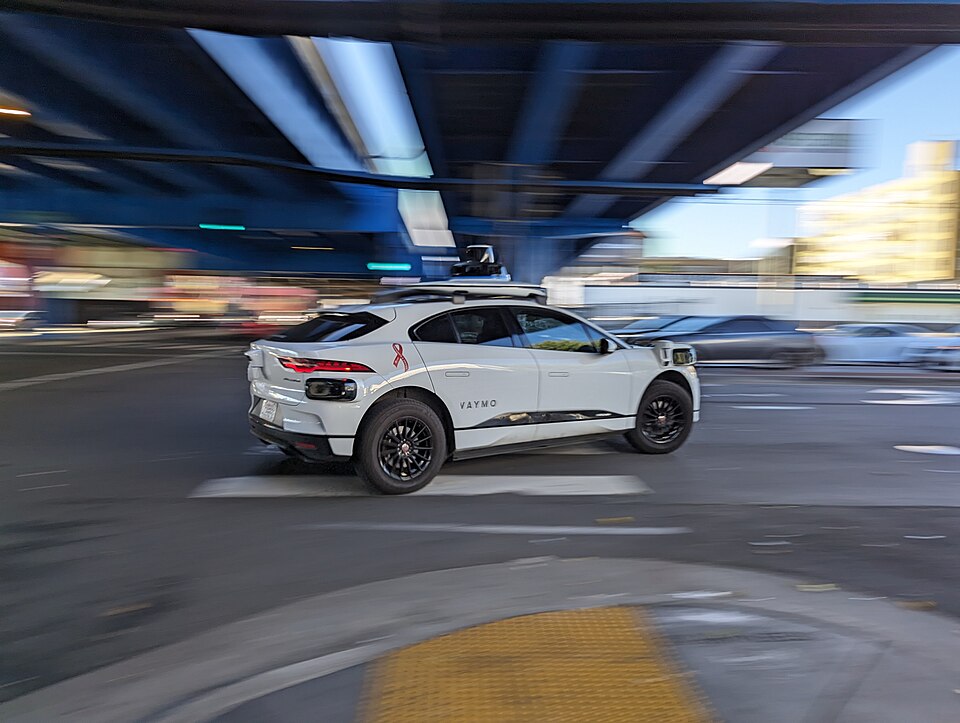
Waymo robotaxis at 13th & South Van Ness. Photo by Mliu92, via Wikimedia Commons (CC BY-SA 3.0).
Riding my bicycle through the Mission District of San Francisco, I’ve got the same protocol at every intersection, with every vehicle I encounter: peer through the windshield, find the face, and try to catch the eyes. Sometimes I get a courteous wave. Sometimes an expressionless stare. But more often than I’d like, the eyes are down—at a phone, presumably—and I have to figure out when and how to proceed so that I don’t get hit.
The San Francisco Chronicle recently polled San Francisqueños about autonomous vehicles (AVs):
42% good, 18% bad, and a big fat 39% sitting in the middle with mixed feelings. The Chronicle then breaks the results down by demographic—Progressive, Liberal, Moderate, Conservative, Male, Female, College-educated, No college degree—but I’d like to see it sliced by Runner, Cyclist, and ¬Runner/Cyclist, because any San Franciscan who runs or rides through the city would rather share the road with a fleet of Waymos than with the average set of motorists, in a heartbeat. And I suspect very few of them would land in that 39% middle, because the middle isn’t where you sit after you’ve had a close call.
The peer-reviewed safety record is lopsided in Waymo’s favor: 82% fewer injury crashes involving cyclists, 92% fewer involving pedestrians, 82% fewer involving motorcyclists, measured against human drivers in the same places.1
There are good drivers out there (mil gracias), but most of us famously overestimate our talent.2 And look, bumping a Model T down an empty gravel road was one thing, but we aren’t built with the reaction time or the processing bandwidth for today’s traffic complexity.
But the deeper problem isn’t the average driver at all, because cycling safety isn’t a function of the average driver; rather it’s a function of the worst one. Ninety-nine attentive drivers don’t protect you from the hundredth.
None of which means the AVs are there yet. There are real gaps left to close, and one of the sharpest complaints about robotaxis in this city comes from cyclists, not from Luddites: Waymo has told the SF Bicycle Coalition that pulling into bike lanes for pickups and dropoffs is “normal practice,” and that keeping out of them is “too high a bar.” A cyclist is currently suing after she was doored by an exiting passenger in a marked lane and thrown into a second Waymo blocking the same lane. But notice that failure isn’t perception or judgment or reaction time; it’s a (changeable) product decision—which is precisely why I’m bullish: because a defect fix improves the entire Waymo fleet at once whereas there’s no equivalent patch for our worst drivers; there’s only a reprimand issued after somebody’s already dead.
(Also, yes, we must acknowledge that drivers will lose jobs. That’s a real cost and I don’t mean to wave it away in a parenthetical; it’s just not apropos of this post.)
You can’t make eye contact with a Waymo, but of course you don’t need to, because it’s already more reliable than its human counterpart, which makes you realize that eye contact is just a mediocre proxy for reliability, an attempt to infer a stranger’s intention through the glass at 20 mph.3
Time to hand over the keys, folks. Jeeves is electric now, and isn’t looking at his phone.
— ᴘ. ᴍ. ʙ.
Kusano, K., Scanlon, J., et al., “Comparison of Waymo Rider-Only crash rates by crash type to human benchmarks at 56.7 million miles,” Traffic Injury Prevention (2025). ↩
Svenson, O., “Are we all less risky and more skillful than our fellow drivers?” Acta Psychologica 47 (1981): 143–148. Successfully replicated by Koppel et al. (2023), N = 1,203: 91% rated themselves safer and 93% more skilled than the average driver. ↩
Though there are people working on how these things might signal intent to the rest of us, and I’m sure it’s a harder design problem than it sounds, but it sure would be nice to have both the confirmation and the competence. ↩