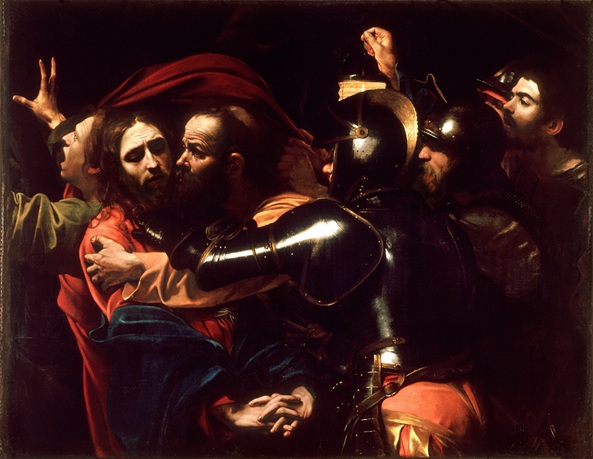
 The Taking of Christ, Caravaggio (c. 1602). The figure holding the lantern at right is believed to be Caravaggio himself — present at the betrayal, looking on. He doesn’t exempt himself from the scene…and neither can we.
Remember Cops & Robbers? It was clear: there were good guys and there were bad guys. The world made sense.
And then you get older, and life and literature1 instruct us that evil can be more nuanced: e.g., ends justify the means conflicts, the corruption of the good / redemption of the evil, etc.
But at the same time there are narratives that keep bringing us back to cosmic dualism: maybe best expressed in our cancel culture or true crime culture where we virtue signal through performative outrage.
The first move for those condemning others in the town square (Twitter/X, Substack, etc.) is to first to put some distance between themselves and the other guys: affirmation of self; discounting and forgetting my own sins. And then it’s: oh, I would never do that. I would never say that. Because I’m not perfect, but at least I’m not like him…who is almost evil.2
In fact there’s a concept called moral pollution which describes acting like bad reputations are contagious, and mere proximity to something labelled immoral is dangerous/toxic. Brands cut ties with people deemed unethical not because they value ethics, but because they fear contamination (cancellation as moral quarantine).
But Aleksandr I. Solzhenitsyn is much more thoughtful in The Gulag Archipelago:
Gradually it was disclosed to me that the line separating good and evil passes not through states, nor between classes, nor between political parties either—but right through every human heart—and through all human hearts. This line shifts. Inside us, it oscillates with the years. And even within hearts overwhelmed by evil, one small bridgehead of good is retained. And even in the best of all hearts, there remains…an unuprooted small corner of evil.
That’s not to say we can’t and ought not name evil and seek it out and fight it courageously, but it does mean that we should do so with humility and not triumphalism.3
The Roman playwright Terence put it this way: Homo sum, humani nihil a me alienum puto (“I am a human being; nothing human is alien to me.”) Maya Angelou returned to this line throughout her life, and explained why it matters:
‘I am a human being. Nothing human can be alien to me.’ If you can internalize at least a portion of that, you will never be able to say of an act, of a criminal act, ‘Well I couldn’t do that.’ No matter how heinous the crime, if a human being did it you have to say ‘I have in me all the components that are in her, or in him…’
Because after all, sin (mysterium iniquitatis) entered the world and we’re naive if we deny it or put our blinders on. Remember the line from The Usual Suspects: “The greatest trick the Devil ever pulled was convincing the world he didn’t exist.” There’s indeed a dangerous trap to avoid: if I think myself too “good” I might move toward believing I’m not in need of a savior—save me from what?—which might mean I’ve already “earned” heaven from being such a good guy. This is Pelagianism and it’s rampant.
Revelation 3:16-17:
So, because you are lukewarm, neither hot nor cold, I will spit you out of my mouth. For you say, ‘I am rich and affluent and have no need of anything,’ and yet do not realize that you are wretched, pitiable, poor, blind, and naked.
If that’s the Christian lens, the behavioral economics lens is the Licensing Effect, where believing you’re good can actually make you behave badly: i.e., those who consider themselves virtuous worry less about their own behavior, making them more susceptible to ethical lapses.
And how do you end up considering yourself virtuous? By defining virtue4 yourself, on your own terms; as opposed to looking to scripture and law, the saints and philosophers, etc.
So what do we do with all this? We can’t stop naming and calling out and thwarting evil lest we succumb to cowardice — but that must be balanced with humility.
Dom Christian de Chergé was a Trappist monk who remained in Algeria knowing he would likely be killed…and was. Shortly before his martyrdom, he wrote: “I have lived long enough to know that I am an accomplice in the evil which seems to prevail so terribly in the world, even in the evil which might blindly strike me down.”
The Taking of Christ, Caravaggio (c. 1602). The figure holding the lantern at right is believed to be Caravaggio himself — present at the betrayal, looking on. He doesn’t exempt himself from the scene…and neither can we.
Maybe the nuance here is that instead of letting people off the hook, there is still an accounting; but instead of demonizing and continuing to hold in contempt, this humility we speak of requires forgiveness. C. S. Lewis says that to be a Christian means to forgive the inexcusable because God has forgiven the inexcusable in you.
The theological ground for this is Imago Dei: that every human being, however contemptible by their actions and disfigured by sin, bears the image and likeness of God. Sin obscures that image, but cannot erase it. Despite everything, they remain a child of God—someone for whom Christ died.
This is the corrective to both the cancel culture impulse and the Pelagian trap: not the relativizing I guess what they did wasn’t so bad, but I share in the same fallen nature, and I am commanded to love what God loves.
— ᴘ. ᴍ. ʙ.
The Brothers Karamazov, Les Misérables, Hamlet, Fargo, etc. ↩
Aristotle noticed this, too: in his Nicomachean Ethics IX.4 he observes that ordinary men, “poor creatures though they may be,” exhibit the marks of self-friendship precisely because they are “satisfied with themselves and think they are good.” ↩
St. Nicholas remembered this about all children: in Hungary he leaves both treats and some twigs (a switch), because no one is either all good nor all bad. ↩
I won’t go all the way down the relativism rabbit hole, but this reminds me of Bishop Robert Barron’s frequent citation of the 1992 Supreme Court case Planned Parenthood v. Casey, where he highlights the passage authored by Justice Kennedy: “At the heart of liberty is the right to define one’s own concept of existence, of meaning, of the universe, and of the mystery of human life.” ↩
First published: 2026-05-06 | tweet | cast | subscribe